The JCB ProAir HVLS Series is engineered for maximum airflow, year-round climate control, and minimal energy consumption.
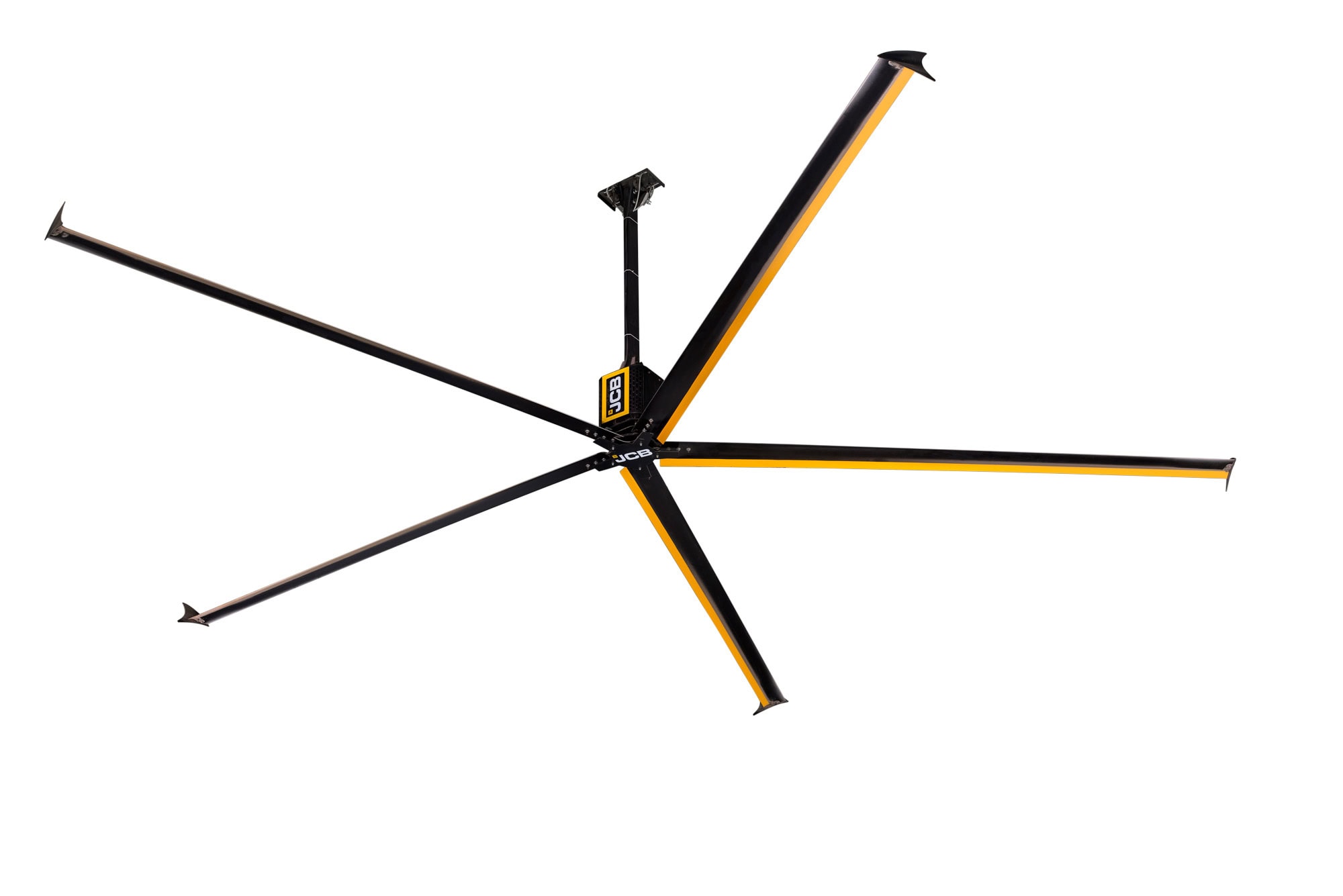
Conventional fan arrays consume significant energy while delivering inconsistent coverage and generating disruptive noise across the spaces they serve. The JCB ProAir HVLS Series eliminates all three problems simultaneously. Five aerofoil blades in diameters from 2.43m to 7.3m move up to 640,527 m³/h of air at below 50 dBA, covering up to 1,570 square metres per unit. A German-engineered IE5-equivalent PMSM direct-drive motor consumes a maximum of 1.1 kW at peak load. Zero maintenance requirements. 100,000-hour service interval. Five models serving every scale of dairy, industrial, and agricultural application.
The ventilation challenge in large-span agricultural and industrial environments is not simply moving air, it is moving enough air, evenly, quietly, and at an energy cost that makes the solution economically rational. Conventional fan arrays address this challenge with multiple small high-speed units that collectively consume significant electrical power, generate cumulative noise levels that affect both animal welfare and worker comfort, create inconsistent airflow distribution with hotspots and dead zones between fan positions, and require the ongoing maintenance of multiple motor, bearing, and drive assemblies across their service lives. The JCB ProAir HVLS range is engineered to replace that approach with a single, superior alternative.
HVLS Technology: The Physics of Better Airflow
High-Volume, Low-Speed fan technology operates on a fundamentally different aerodynamic principle than conventional high-speed fans. A large-diameter aerofoil blade rotating at low RPM moves a substantially greater volume of air per revolution than a small-diameter blade rotating at high speed and it does so, at a velocity that distributes evenly across a large floor area rather than creating the concentrated jet streams that high-speed fans generate. The result is a large, cylindrical column of air moving downward from the fan and outward across the floor in all directions, creating a broad, even airflow pattern that covers the full coverage area with consistent air velocity rather than concentrating cooling effect in a narrow zone below the fan.
This airflow pattern is more effective for both cooling and destratification than conventional fan output for two reasons. For cooling, the even low-velocity air movement across the full floor area maximises the evaporative cooling effect from body surfaces across every animal or occupant in the space, not only those directly beneath the fan. For destratification, the large-diameter blade geometry creates the gentle convective mixing that redistributes stratified warm air from roof level to floor level most effectively without the turbulence that high-speed fans generate when operated in reverse.
Motor Engineering: The JCB ProAir Efficiency Advantage
The German-engineered EMF Permanent Magnet Synchronous Motor is the engineering component that makes the ProAir’s energy efficiency performance remarkable. IE5-equivalent efficiency class, the highest motor efficiency rating in the European classification system, combined with direct gearless drive means that virtually all electrical input is converted to rotational output without the transmission losses, heat generation, and mechanical wear that geared motor systems introduce. Maximum power consumption across the range peaks at just 1.1 kW for the 7.3-metre ProAir 24DX covering 16,900 square feet. The smaller ProAir 8DX and 12DX models consume 0.3 kW at maximum load; a fraction of the power that a conventional fan array covering equivalent floor area would require.
The PMSM brushless design eliminates the brush wear that limits conventional motor service life, removing the primary maintenance requirement of conventional motor systems. The result is a motor that requires no scheduled maintenance, operates continuously without degradation, and reaches its 100,000-hour service interval, equivalent to over 11 years of continuous 24/7 operation before scheduled service is required.
Agricultural Applications: Dairy, Livestock, and Poultry
The JCB ProAir range was originally developed for dairy barn ventilation, the application that first identified the need for quiet, high-volume, low-disturbance airflow across large occupied spaces. In dairy operations, heat stress is one of the most commercially significant and most directly preventable production risks. Cows experience heat stress around approximately 25°C, with the consequent reductions in milk yield, conception rates, dry matter intake, and immune function that compound across a summer season into thousands of dollars of production loss per affected animal. The ProAir’s ability to maintain consistent low-velocity airflow across the full barn width at noise levels that do not distress animals or suppress natural resting and feeding behaviour, makes it the optimal ventilation solution for both heat stress prevention and year-round air quality management in dairy environments.
The forward/reverse operating capability provides the additional benefit of winter destratification, recovering the heated air that naturally stratifies at roof level and recirculating it to floor level where it reduces supplementary heating requirements across cold-weather periods.
Industrial and Agricultural Versatility
The same airflow physics and motor engineering that make the ProAir exceptional in dairy barn applications perform equally effectively in warehouses, processing plants, manufacturing facilities, equestrian centres, and any large-span enclosed space where air quality, temperature management, and energy efficiency are operational priorities. A single ProAir 24DX covering 16,900 square feet at 0.98 kW maximum power consumption represents a ventilation solution that no conventional fan configuration can match on the combined metrics of coverage per unit, energy consumption per cubic metre of air moved, noise output, and maintenance cost over service life.
Installation and Control
The universal mounting assembly is compatible with I-beams, solid beams, C-channels, trusses, and box sections, providing the structural flexibility to install ProAir fans in virtually any existing building without specialist infrastructure modification. Adjustable mounting post and angle bracket accommodate roof pitch variation and ceiling height requirements across the full building range the system serves. The adjustable angle bracket ensures the fan hangs vertically regardless of mounting structure angle, maintaining the airflow geometry the system is engineered to deliver. Control options range from hard-wired panel with touchscreen interface to Modbus WiFi cloud connectivity via LAN, providing the monitoring and adjustment capability that both on site operational management and remote facility oversight require.