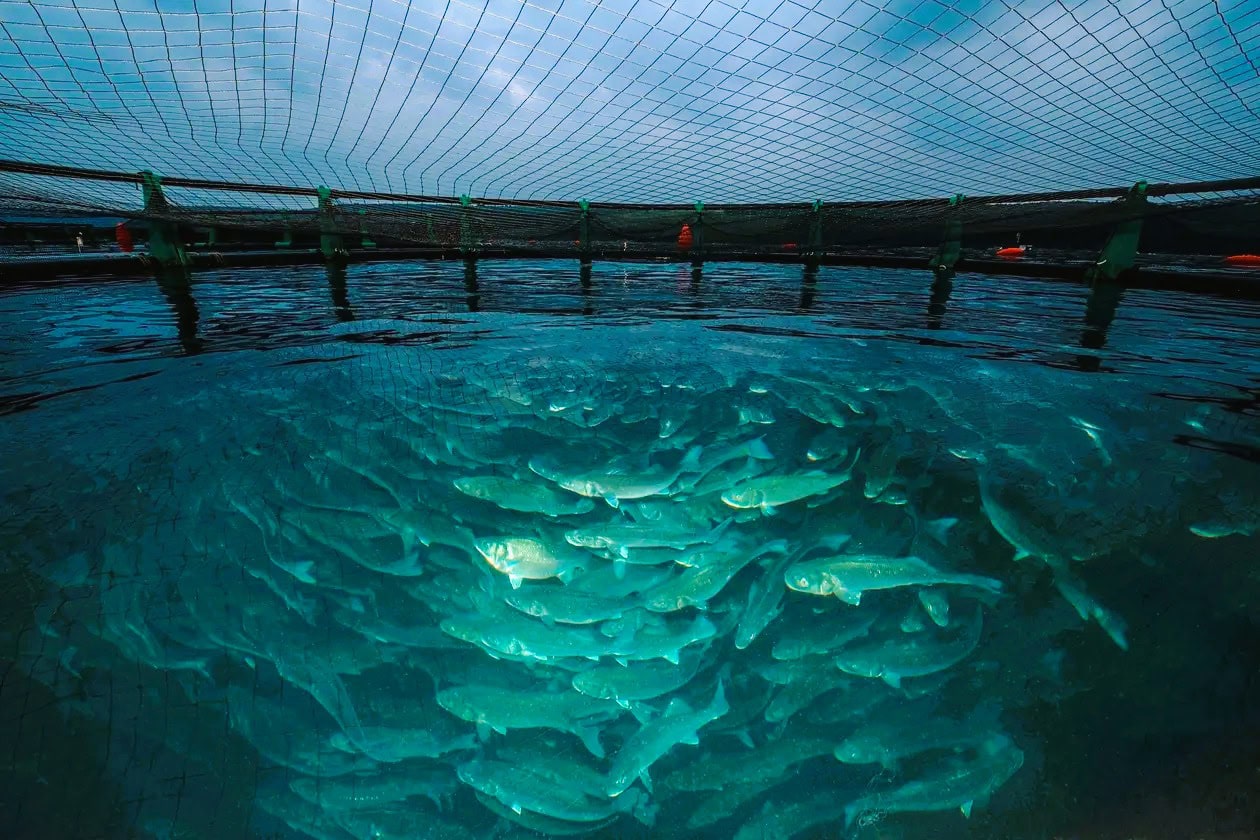
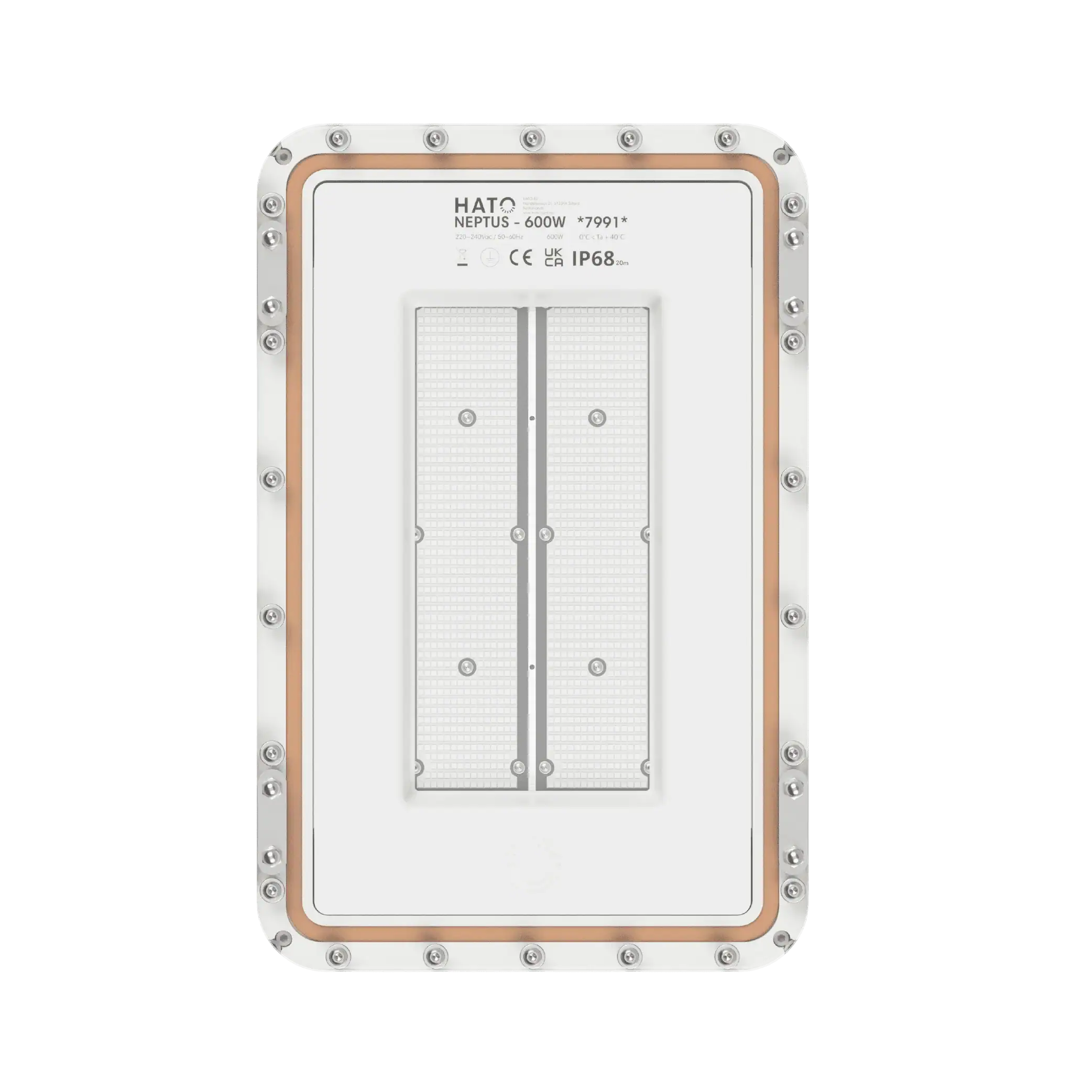
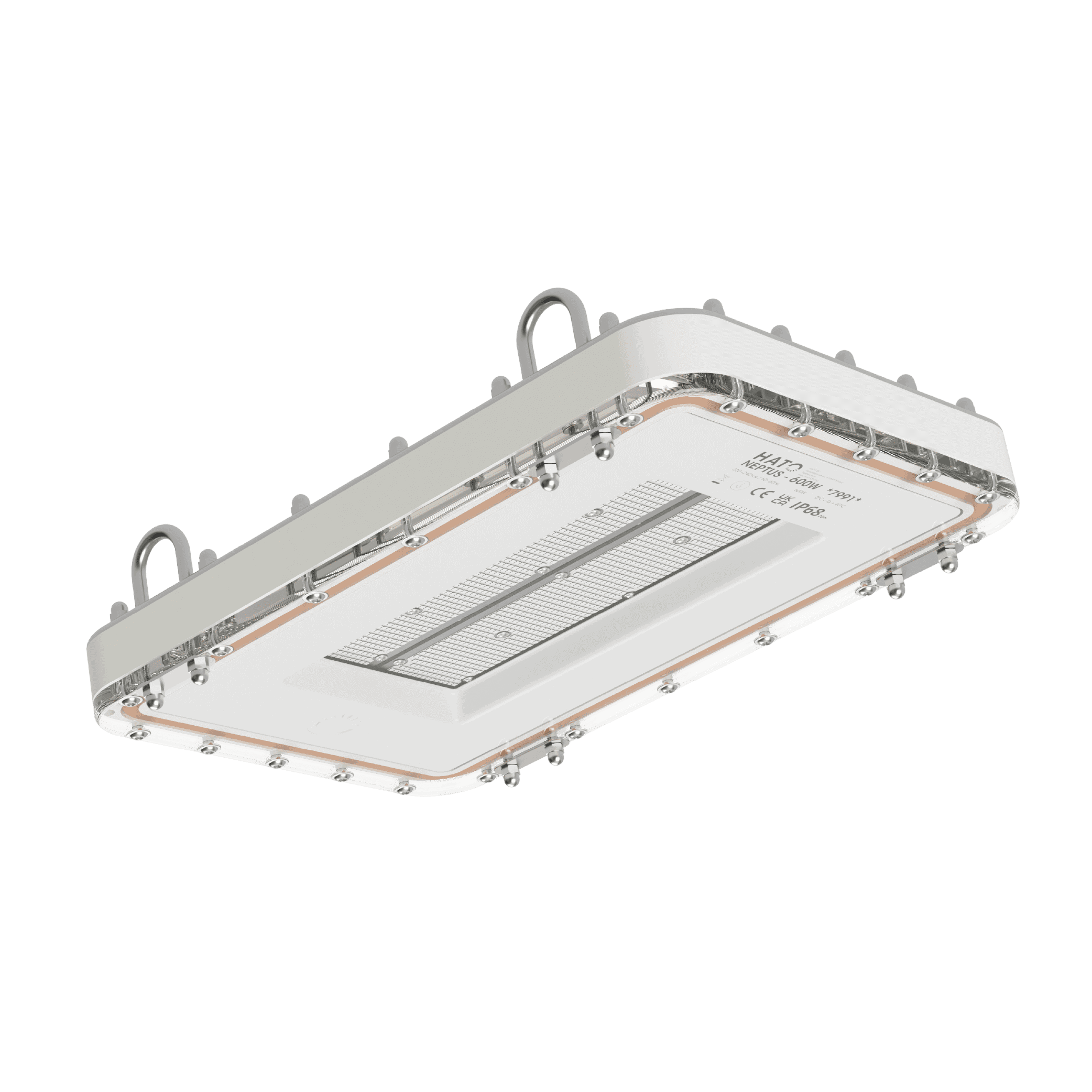
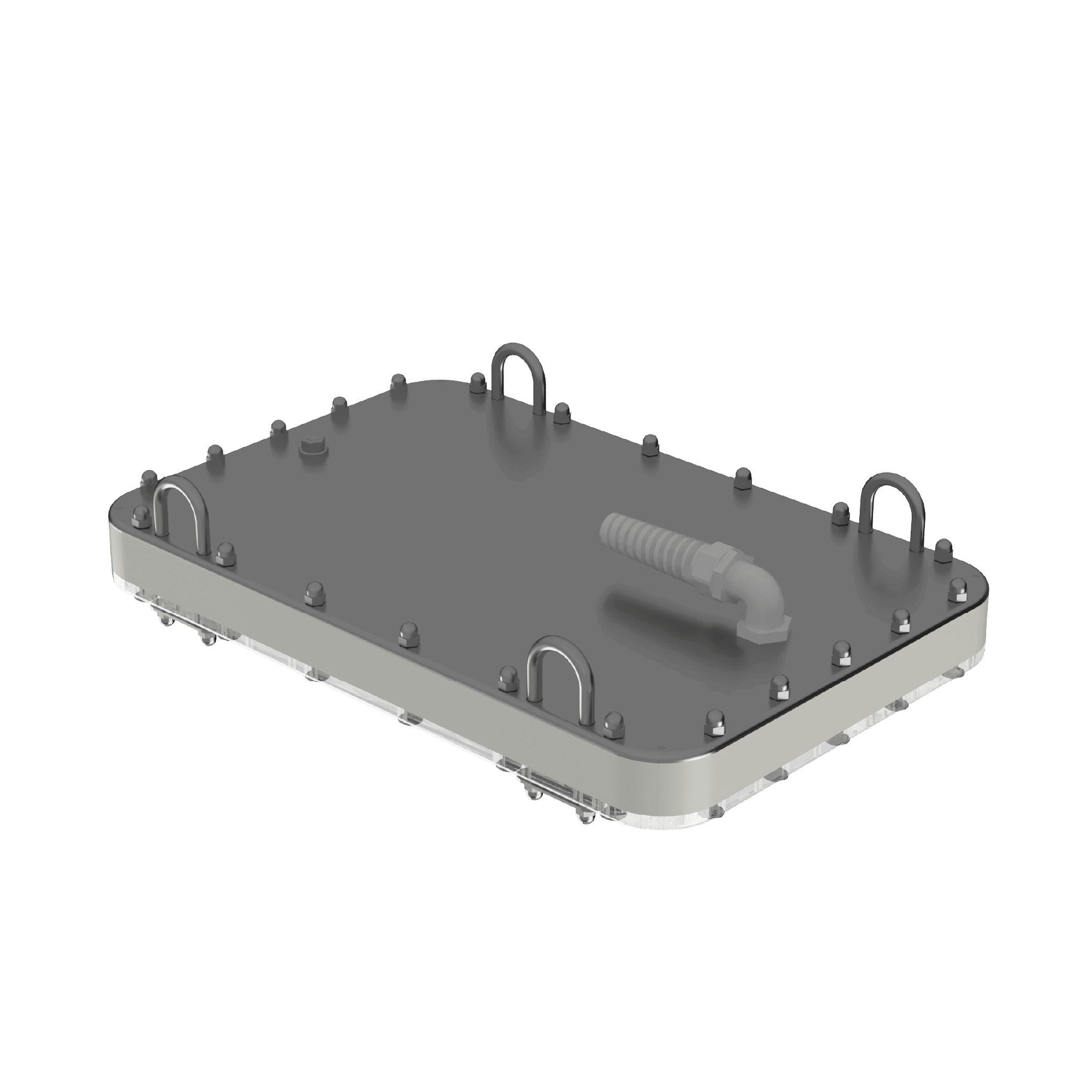
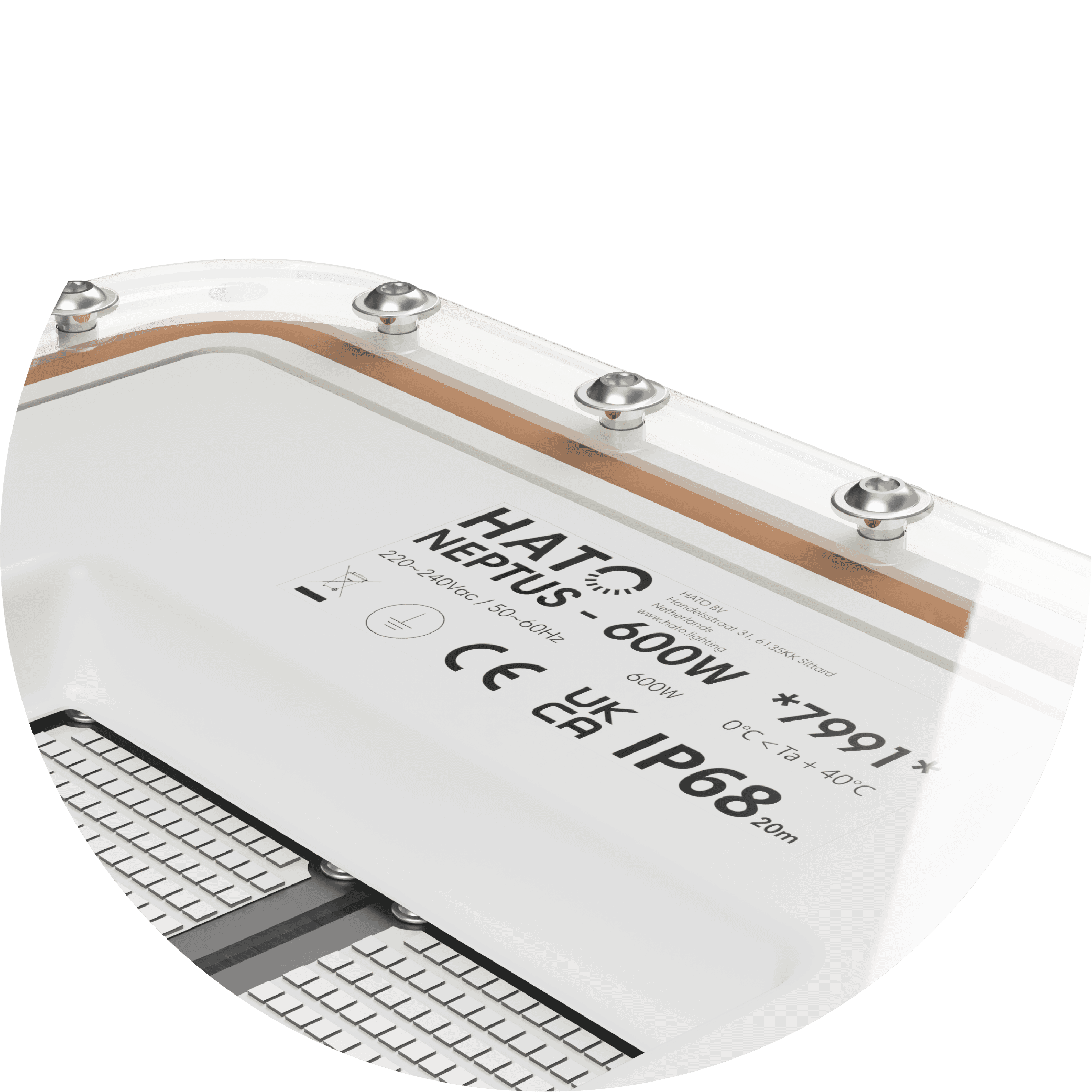

Light is one of the most powerful and precisely controllable biological drivers in aquaculture production. The HATO NEPTUS submersible LED fixture delivers a fish-optimised aqua spectrum at up to 98,400 lumens, engineered specifically to accelerate growth rates and control maturation in salmon and aquaculture environments. IP68-rated to 20 metres, flicker-free DALI dimming from 1–100%, marine-grade POM and SS316 construction, and a 70,000-hour LED lifetime combine into the most capable, durable, and production-focused submersible aquaculture light available.
Light is not a passive environmental condition in aquaculture, it is an active biological input with direct and measurable consequences for growth rate, maturation timing, feeding behaviour, and the production outcomes that determine the profitability of every harvest cycle. In salmon farming and intensive aquaculture operations, the management of light intensity, spectrum, and photoperiod is one of the most powerful tools available to the producer for influencing fish biology in commercially meaningful ways. The HATO NEPTUS is engineered to deliver that control, precisely, reliably, and at the depth and durability that real aquaculture environments demand.
Light Spectrum and Biological Performance
The spectral composition of light determines which biological responses it triggers in fish. Broad-spectrum white light illuminates an aquaculture environment, but it does not necessarily illuminate it in the wavelengths that fish photoreceptors respond to most strongly, or in the spectral regions that most effectively drive the biological pathways of relevance to production outcomes. The NEPTUS’s aqua/fish spectrum is engineered specifically for aquaculture biological application, targeting the wavelengths that support growth rate acceleration, feeding activity stimulation, and the photoperiod management that controls maturation in species such as Atlantic salmon.
Maturation control through light management is one of the most commercially significant applications in salmon aquaculture. Early sexual maturation; grilsing, represents a major production loss, as fish that mature early divert metabolic energy from growth to reproduction, reduce in feed conversion efficiency, and deliver lower harvest weight and flesh quality. Precisely managed artificial light during the relevant developmental window suppresses the maturation signal, extending the growth phase and the harvest weight that sustained growth produces. The NEPTUS delivers the spectral precision and intensity consistency that effective maturation management requires.
IP68 at Depth: Engineering for the Aquaculture Environment
The submersible environment presents a combination of mechanical, thermal, chemical, and pressure challenges that terrestrial lighting equipment is not designed to withstand. Saltwater corrosion attacks metal components and seals. Pressure at depth stresses enclosure integrity. Temperature cycling between air and water environments challenges material dimensional stability. Biological fouling affects optical surfaces. And the mechanical handling that comes with installation, maintenance, and operational contact in a working aquaculture environment creates the impact loading that inadequately rated fixtures do not survive.
The NEPTUS addresses each of these challenges through its material and engineering specification. The SS316 marine-grade stainless steel base material provides corrosion resistance appropriate for continuous saltwater exposure, the SS316’s molybdenum content provides substantially better chloride resistance than SS304, the standard specification used in general marine components. The POM polymer components provide the dimensional stability, chemical resistance, and mechanical strength required for the enclosure structure under sustained submersion. IP68 certification at 20 metres provides documented waterproofing integrity under the hydrostatic pressure of full deployment depth. And IK10 impact rating on the fixture body, the maximum available under the IK scale, provides confidence in mechanical robustness under the handling and operational contact conditions of working aquaculture environments.
DALI Dimming and Flicker-Free Operation
The NEPTUS’s DALI dimming system provides full 1–100% intensity control, the precision required for effective photoperiod programming, seasonal light intensity adjustment, and the gradual transition between light and dark periods that minimises stress responses in fish during lighting changes. DALI is the industry-standard dimming protocol for intelligent lighting control systems, providing the communication reliability and control precision that production-critical aquaculture lighting management demands.
Flicker-free operation is not a comfort specification in aquaculture lighting, it is a biological necessity. Fish visual systems are sensitive to light flicker at frequencies that are invisible to the human eye, and flickering light at those frequencies triggers a chronic stress response in fish that suppresses immune function, reduces feed conversion efficiency, and compromises the growth performance that the lighting investment is intended to support. The NEPTUS’s 100% flicker-free operation eliminates that stress pathway entirely, ensuring that the biological benefit of the lighting programme is not undermined by the delivery mechanism.
70,000-Hour Lifetime: The Maintenance Advantage
LED lifetime is the primary maintenance cost driver in underwater lighting installations. Every lamp replacement in a submersible application requires either diver access or system retrieval, an operational intervention that is significantly more costly and disruptive than lamp replacement in terrestrial environments. The NEPTUS’s 70,000-hour expected LED lifetime minimises replacement frequency across the operational life of the installation, reducing the number of maintenance interventions required, the associated operational disruption, and the total maintenance cost that replacement frequency accumulates over years of continuous use. At typical aquaculture photoperiod schedules, a 70,000-hour LED lifetime translates into many years of operation before replacement is required, providing the operational reliability and maintenance cost certainty that a production critical lighting investment demands.
High Efficacy: Production at Lower Operating Cost
At 164 lm/W, the NEPTUS delivers exceptional luminous efficacy, the ratio of light output to electrical power consumed that determines the operating cost of achieving a given light intensity at fish level. Both the 300W model (49,200 lm) and the 600W model (98,400 lm) deliver the same efficacy, providing installation flexibility for different tank sizes, deployment depths, and intensity requirements without any penalty in energy efficiency. For operations running continuous or extended photoperiod programmes, the energy cost of aquaculture lighting is a significant operational line item and 164 lm/W efficacy ensures that biological benefit is maximised relative to every kilowatt consumed.
HATO: Four Decades of Aquaculture Lighting Expertise
The NEPTUS is the product of HATO’s decades of specialist aquaculture lighting development. A Netherlands-based company established in 1974 with deep expertise across animal lighting applications including fish, poultry, and livestock. HATO’s aquaculture lighting solutions are deployed across salmon farming, land-based systems, and hatchery environments globally, providing the operational experience base that translates into products engineered for real aquaculture conditions rather than laboratory specifications. The NEPTUS represents HATO’s current state of the art in submersible aquaculture lighting built on legacy, tuned by operational experience, and ready for the demands of modern fish production.